The Room
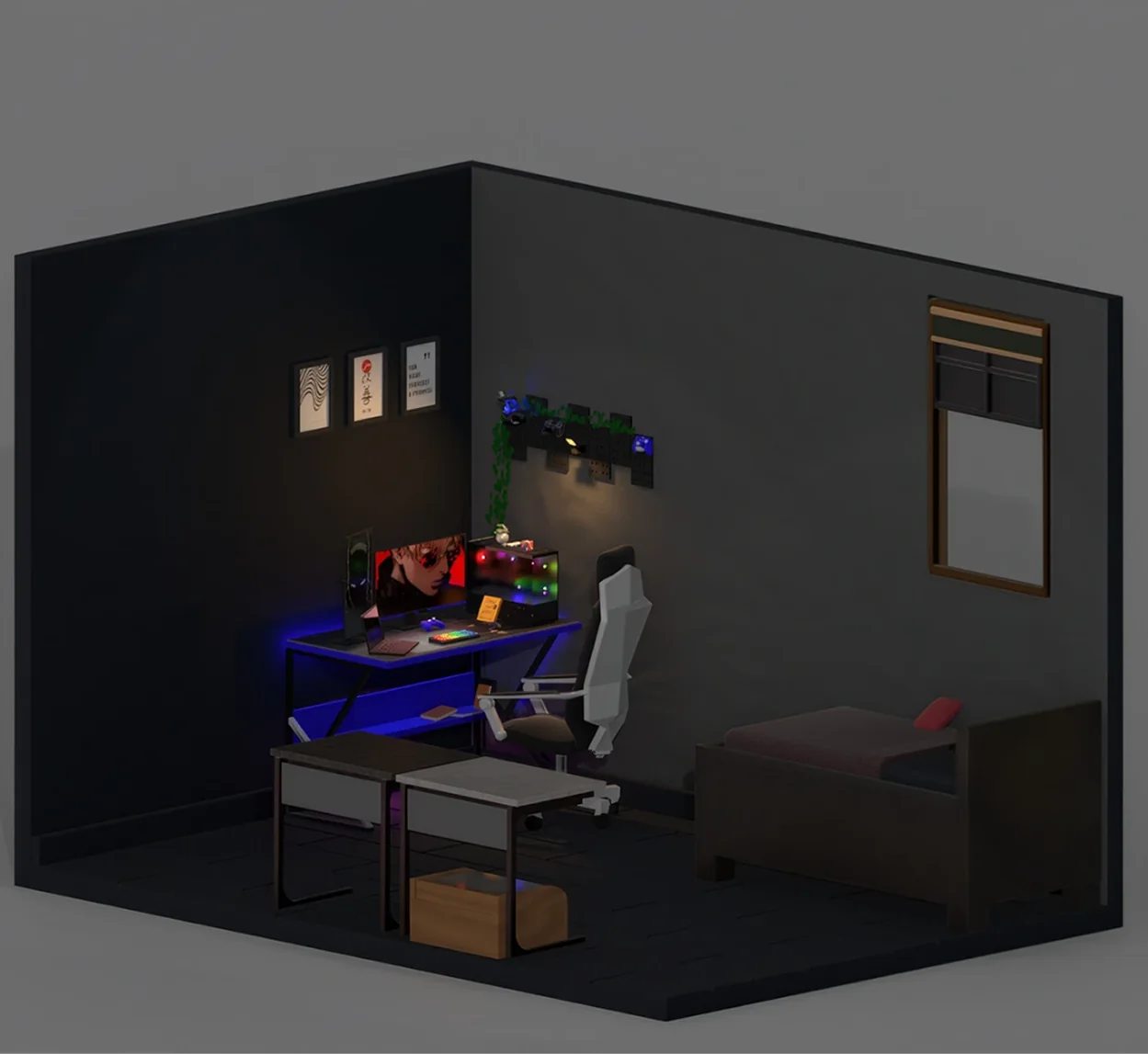
The room this entire portfolio is built around. Modelled in Blender as an isometric cutaway (two walls and a floor, so the camera can look in without the geometry getting in its way), then exported to glTF and rendered live in the browser with React Three Fiber.
Built to be navigated
The room is not a render, it is an interface. Six cameras and five target objects are authored in Blender and exported with the model, so each section of the site is a real position in the scene rather than a number hard-coded in JavaScript. Clicking a poster or the monitor flies the camera to the matching view.
The cutaway is a camera decision
A closed box cannot be filmed from outside. Dropping two walls turns the model into a diorama: the fixed isometric angle always has a clear line into the desk, the bed and the posters, and the open edges let the page background read through instead of ending in a hard silhouette.
Paid for in milliseconds
Everything a browser renders every frame has to justify itself. Textures came down to 256px, geometry was simplified, meshopt replaced the raw buffers, and the material extensions that quietly promote a mesh to the expensive shader path (transmission, sheen, clearcoat) were stripped out. Transmission is the worst offender: it makes three.js render the whole scene a second time, every frame, for refraction. The file went from tens of megabytes to 1.40 MB, and it holds framerate on integrated graphics.
Modelled from the actual room
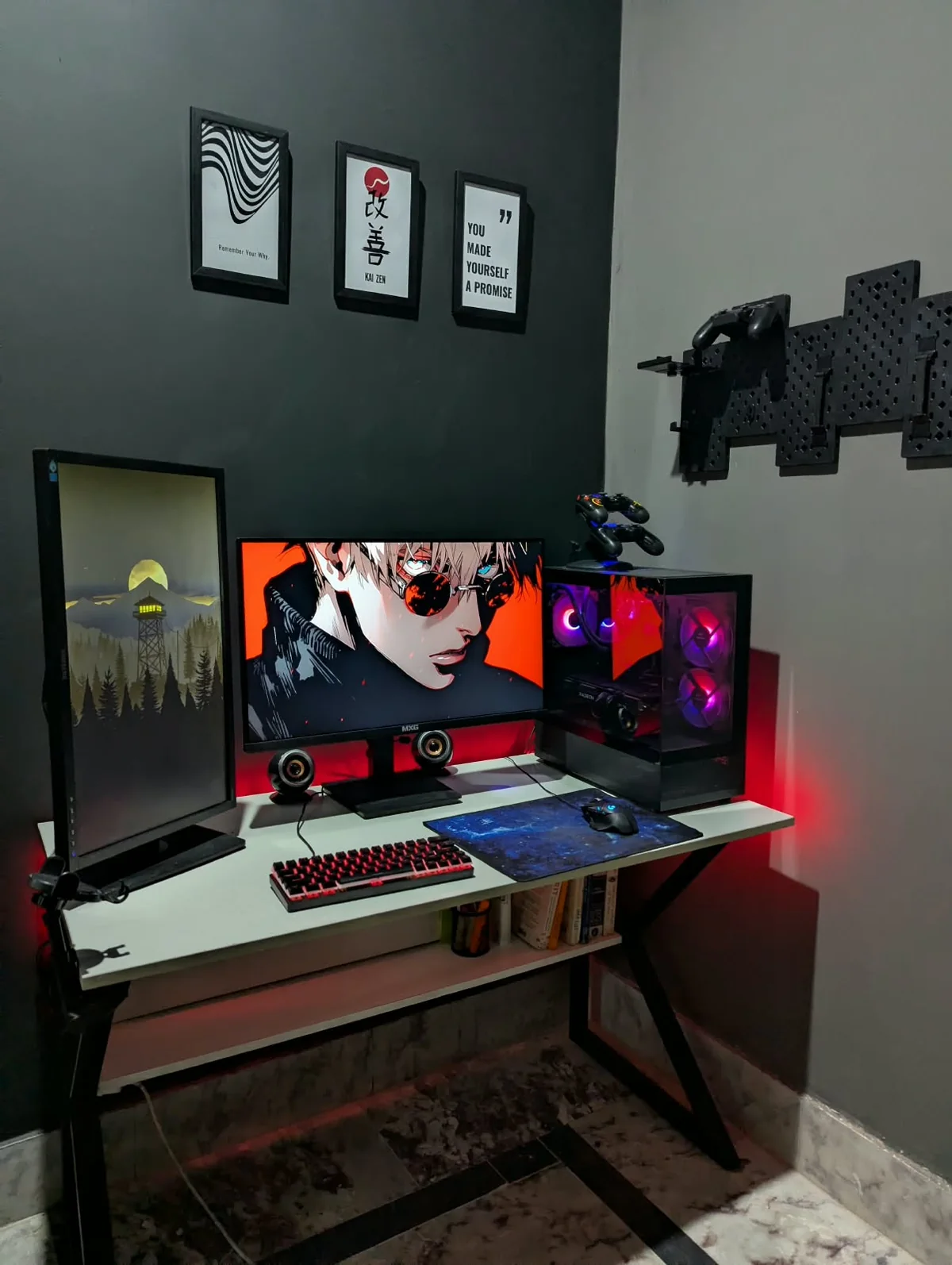
It is my own desk, not a stock interior. The three framed prints, the pegboard, the vertical second monitor, the RGB tower and the red underglow all exist. That is the point of using it as the landing page: a portfolio built around a generic 3D office says nothing about the person, and this one has to survive being held up against the photograph.
Where the quality went
Visible loss was accepted on purpose. At the size the room is displayed, a 256px texture and a simplified mesh are close to indistinguishable from the originals, while the load and the frame cost are not close at all.
Highlights
- Isometric cutaway built so a fixed camera always has a clear line into the scene.
- Six cameras and five click targets authored in Blender and carried through the export.
- Compressed to 1.40 MB with meshopt, 256px textures and mesh simplification.
- Expensive material extensions stripped, transmission alone costs a full extra scene pass per frame.
- Rendered with React Three Fiber, with adaptive DPR so a weak GPU degrades instead of stuttering.
Mobile is served a still image of this model rather than a live canvas. A phone gets the picture without paying for the renderer.